
Counselling, CBT, ACT, DBT, Psychodynamic, Humanistic & More: What's Actually the Difference?
Counselling, CBT, ACT, DBT, psychodynamic, humanistic, interpersonal, couple therapy - confused by the terms? Here's a clear, jargon-free guide to what each one means and which fits you.
GETTING HELPMENTAL HEALTH THERAPY
Supreet Dhiman
12/15/20255 min read
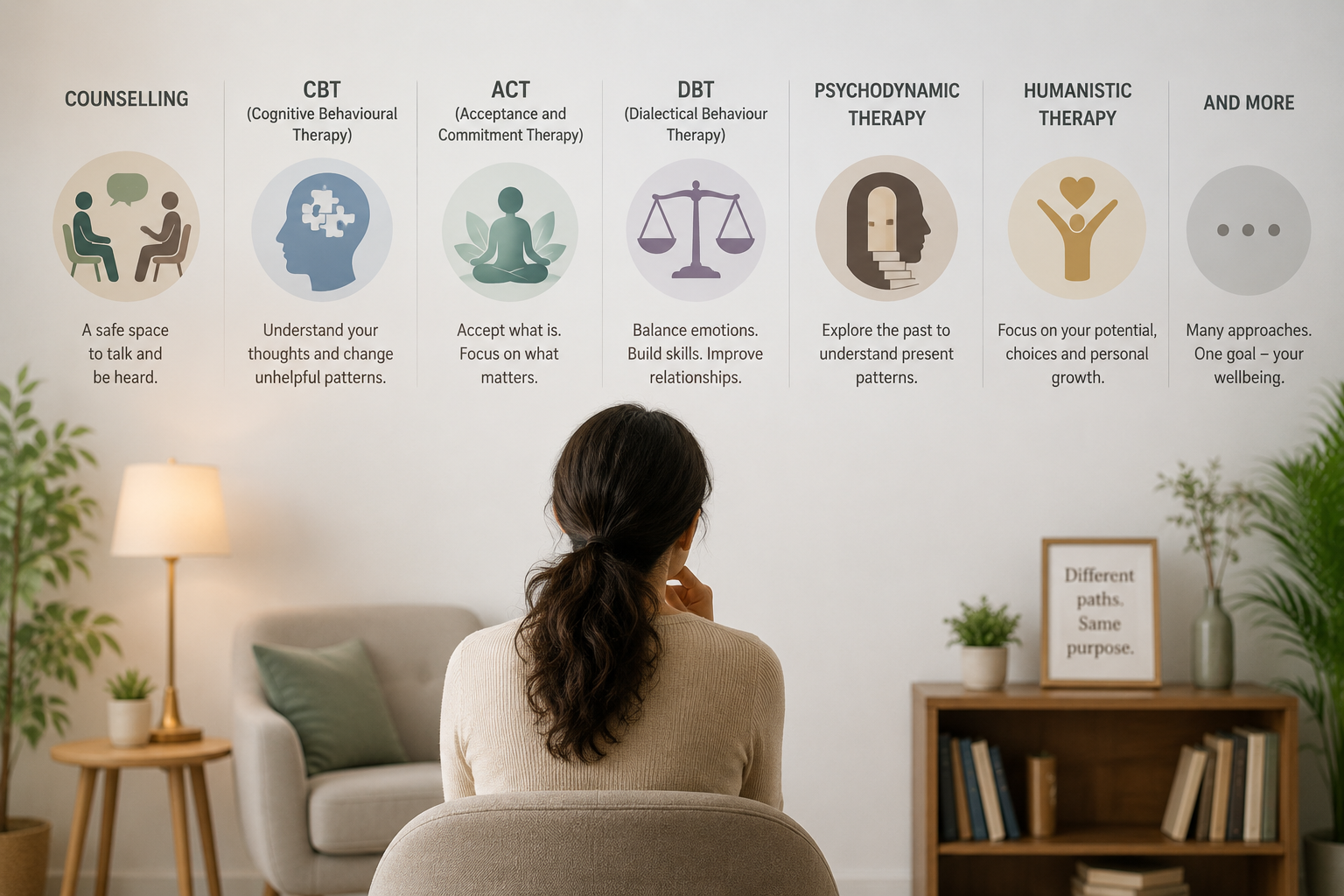
Walk into almost any conversation about mental health support and the terms start piling up fast - counselling, psychotherapy, CBT, ACT, DBT, psychodynamic, humanistic, narrative, gestalt, interpersonal, emotion-focused, family and couple therapy. Sometimes they're used interchangeably. Sometimes they're presented as a hierarchy, as though one is more "serious" than another. Neither is quite right, and the confusion is real. No wonder clients often arrive unsure what they've signed up for, or whether the approach being used is even right for what they're dealing with.
Here's the clearest way to think about it: counselling and psychotherapy describe the depth and timeframe of the work. Everything else on that list describes the specific method used to do it. Two different questions - how long and how deep, versus how.
Counselling vs. Psychotherapy: The Depth Question
Counselling is shorter-term and focused on a present, specific concern - a stressful decision, a recent loss, a particular conflict - working toward practical clarity and coping strategies over a contained period.
Psychotherapy goes deeper and longer, addressing patterns that repeat across time and situations - recurring anxiety, longstanding low mood, relationship patterns that show up with different people, trauma still shaping present behaviour.
Neither is more legitimate than the other - they suit different situations, and it's common to start with one and discover the other actually fits better.
The Method Question: A Quick Comparison
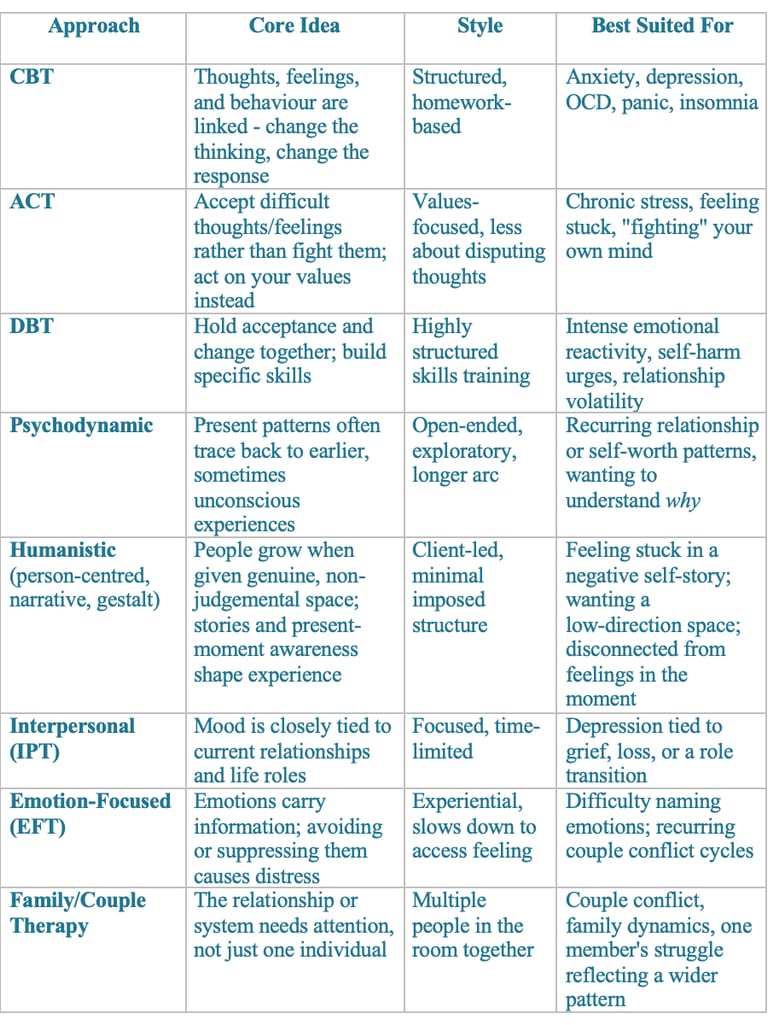
Once you know roughly how deep the work needs to go, the next question is which method gets used within it. Here's how the main approaches compare at a glance:
A Little More on Each
- CBT identifies distorted thinking patterns - catastrophising, all-or-nothing thinking - and systematically restructures them alongside behaviour change. Practical and usually fast-moving.
- ACT works on your relationship to difficult thoughts rather than disputing their accuracy, anchored in values clarification - what actually matters to you, and building toward that despite discomfort.
- DBT centres on four skills: mindfulness, distress tolerance, emotional regulation, and interpersonal effectiveness - originally built for intense emotional dysregulation, now used more broadly.
- Psychodynamic therapy explores recurring themes across your history, particularly early relationships, often using the therapist relationship itself as a live example of your broader patterns.
- Humanistic approaches share a belief in your innate capacity for growth, expressed through a few traditions: person-centred (unconditional positive regard, minimal direction), narrative (separating you from a limiting self-story - "the problem is the problem, not you"), and gestalt (present-moment, experiential awareness of what you're feeling right now).
- Interpersonal therapy stays focused on one or two relational areas - grief, a role transition, a relationship conflict - working concretely on communication and expectations within that specific area.
- Emotion-focused therapy helps you slow down and access underlying emotions, often ones sitting beneath a more obvious surface feeling, both individually and - very commonly - in couple work centred on attachment needs.
- Family and couple therapy brings the relevant people into the room together, examining communication patterns and conflict cycles as they play out live, often drawing on several of the methods above.
How These Fit Together
None of this is locked into rigid categories. A person in counselling for a job transition might use CBT for the anxious thoughts. Someone in longer-term psychotherapy untangling a lifelong pattern might draw on ACT for values clarity and psychodynamic work to understand its roots. A couple stuck in the same argument might work with emotion-focused or family systems approaches together, rather than each partner going it alone.
A well-trained clinician typically blends more than one method, tailoring the mix as the work unfolds rather than applying a single fixed template.
A Simple Way to Decide
Specific, identifiable negative thoughts driving things - CBT
Feeling stuck, disconnected from purpose, exhausted fighting your feelings - ACT
Intense, hard-to-manage emotional reactions - DBT
A pattern you keep repeating and want to understand the roots of - Psychodynamic
Wanting a client-led space, or stuck in a negative self-story - Humanistic
Distress clearly tied to a relationship, loss, or transition - Interpersonal
Trouble naming or accessing your emotions - Emotion-Focused
The struggle involves a couple or family, not just you - Family/Couple Therapy
Not sure at all - completely normal as that's what an initial consultation is for.
Why This Matters for Your Expectations
Knowing this changes what to expect. CBT and DBT bring structured exercises and homework. ACT brings values work. Psychodynamic and humanistic approaches are more open and exploratory, unfolding over a longer arc rather than fixed exercises. Interpersonal therapy stays tightly focused on one relational issue. Emotion-focused work slows down to actually feel, often experientially. Family and couple work involves more than one person in the room. None should feel aimless - all are active and moving toward something, just via different mechanisms.
If a session doesn't match what you expected, it's reasonable to ask your clinician what approach is being used and why.
You Don't Need to Diagnose Your Own Approach
The point of knowing these differences isn't to prescribe your own treatment plan. Rather, it is to understand what's happening in the room and recognise that "therapy" isn't one uniform experience.
At Shaping Destiny, our approach draws on CBT, ACT, trauma-informed care, mindfulness-based practices, and other evidence-based methods where relevant - including relational, family, and couple-focused work where more than one person's dynamic needs attention. Every plan starts with understanding what you need before deciding how to get there.
Not sure which approach fits you?
That's exactly what our Wellbeing Call is for - Book yours today. https://bit.ly/SDiscoveryCall
Frequently Asked Questions
Do I need to choose an approach before I start? No. Your clinician will assess what you're bringing and recommend an approach, often blending methods as the work develops.
Is one of these approaches more "evidence-based" than the others? CBT, ACT, and DBT have the deepest research base for specific conditions. Psychodynamic, humanistic, interpersonal, and emotion-focused approaches are well-established with their own supporting evidence, particularly for the concerns they specifically target. The right choice is about fit, not a universal hierarchy.
What's the real difference between narrative and gestalt therapy, since both are "humanistic"? Narrative therapy works with the stories you tell about yourself, helping you separate from a limiting one. Gestalt works with present-moment awareness. What you're feeling right now is often explored experientially rather than through discussion alone.
Is psychodynamic therapy the same as classic psychoanalysis (lying on a couch discussing childhood)? Not quite. Modern psychodynamic therapy is generally shorter and more conversational, typically face-to-face, though it shares the core idea that current patterns are shaped by earlier experience.
Why would a whole family need therapy if only one member is struggling? Family patterns are often maintained collectively, even when one member's behaviour is the most visible symptom. Involving the wider family tends to produce more lasting change than treating one person in isolation from an unchanged system around them.
Can my therapist switch approaches if one isn't working? Yes, and this is common. A good clinician will discuss adjusting the approach with you rather than continuing regardless.
Shaping Destiny
Reach out for support or questions
Email: contact@shaping-destiny.com
Phone: +91 98144-14440
© 2026. All rights reserved by Shaping Destiny
Safety Plan
Please note we are not a 24/7 helpline.
If you’re feeling vulnerable or unsafe, please contact someone you trust, your doctor, or use one of these helplines:
India Helplines:
• Tele-MANAS: 14416 / 1800-891-4416
• iCall: 9152987821
• KIRAN: 91529-87821
• Vandrevala Foundation: 99996-66555
• AASRA: 022-2754-6669
You are not alone - please reach out.
office hours: 10am - 4pm IST (Mon-Fri)
Contact
At Shaping Destiny, we believe everyone deserves a life of clarity and meaning. Using proven evidence-based and goal-oriented therapeutic approaches, we help you navigate your emotional world with confidence and care.