
When "Adjust Karo" Becomes a Mental Health Risk
Domestic Stress, Silent Compromise, and Women's Wellbeing in India
WOMEN'S MENTAL HEALTHEMOTIONAL WELLBEING
Supreet Dhiman
12/24/20253 min read
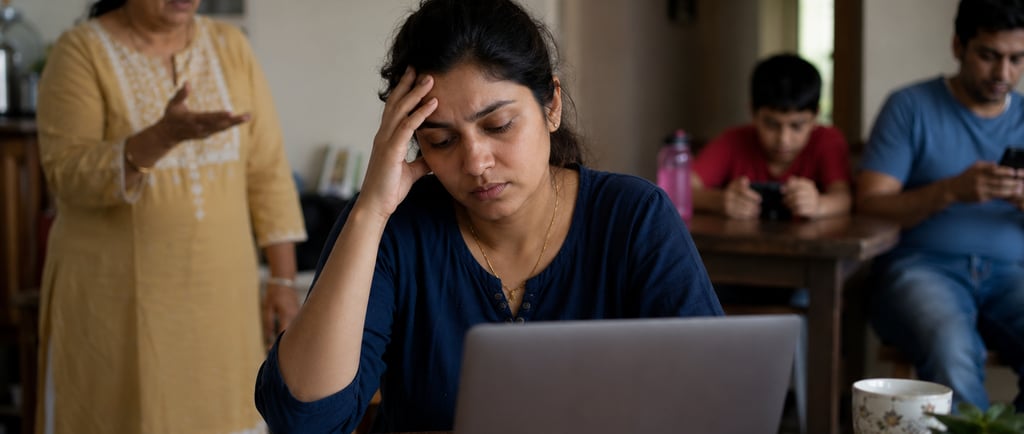
Millions of Indian women hear this advice daily: adjust. With the in-laws. With your career plans. With your marriage. It's usually meant kindly and often by people who adjusted too, believing flexibility keeps a family together. Sometimes it does.
Compromise is a normal part of any relationship. However there's a point where "adjusting" stops being flexibility and becomes erosion - where a woman isn't bending to keep the peace, she's disappearing to keep it. That difference rarely gets named. It's worth naming here.
What Chronic Adjustment Actually Does
Adjusting once, for a clear reason, is a choice. Adjusting endlessly, as the unspoken price of belonging in a family, is a chronic stressor, and it has real psychological costs, even without one dramatic incident to point to for reference.
It can look like:
Exhaustion with no clear cause as holding back your opinions and needs all day is its own quiet labour.
Losing touch with what you actually want after years of prioritising everyone else's comfort.
Guilt before you've done anything wrong for simply wanting something different.
Unexplained physical symptoms such as headaches, fatigue, disrupted sleep.
Resentment with nowhere to go is not always at one person, but at a life built around everyone else's needs.
None of this needs a dramatic incident to be real, which is exactly why it's so easy to dismiss. Think of it as a slow-burn.
Why This Matters
Depression rates among Indian women run roughly double those of men, driven by economic dependence, caregiving load, and family pressure. Domestic violence is part of this picture too as its psychological toll is enormous, and mostly goes untreated, because it rarely gets named as a mental health issue. It gets absorbed as "just how marriage is."
One important reminder: normal compromise is not the same as an unsafe dynamic. If what you're facing involves control, threats, or harm, that needs safety planning and support beyond this article, please take note of the resources given below.
Most "adjust karo" pressure doesn't reach that threshold, though, and still takes a real toll. This piece is about that quieter middle ground, the self-erasure so normalised it's never called a mental health issue at all.
Why It Stays Hidden
There's no single incident to point to - just years of small compromises adding up.
Adjustment is praised, not questioned, so naming its cost can feel disloyal.
There's often no one to tell, as family may be part of the same pattern.
Seeking help still carries stigma, read as failure rather than a reasonable response.
What Actually Helps
The goal isn't to stop compromising, as most relationships need some. It's learning to tell healthy give-and-take apart from a pattern that's costing your wellbeing, and building tools beyond just enduring it.
This usually means: setting boundaries without the guilt that shuts down the conversation first; reconnecting with your own needs, which takes time; processing resentment or grief without needing to blame anyone; and practical coping strategies for a household that isn't changing quickly.
This doesn't require leaving anyone. It just means being honest, somewhere outside the household, about what the current arrangement is costing you.
You're Allowed to Take This Seriously
If you recognised yourself here, trust that. You don't need a crisis to deserve support.
The Circle | Women at Shaping Destiny is built for exactly this: women speaking honestly with other women and trained mental health professionals once a month, without judgment of the family you describe.
If your situation involves control or threats, not just pressure to adjust, then it is more urgent, and deserves immediate attention. Reach out to a trusted person or the National Commission for Women's helpline (7827-170-170), alongside any therapy. Feel free to call Women's Help Line 181 in case of emergencies. Alternatively, Helpline Tele Manas 14416 may be called for local support.
Frequently Asked Questions
Is wanting change the same as wanting to leave my marriage or family? No. Most women seeking support here aren't looking to end relationships. They want to change the terms of how they're participating in them, and feel more like themselves within the life they've built.
What if my family doesn't believe in therapy? You don't need anyone's approval to seek support for yourself. Sessions are confidential, and many women start this work without discussing it with family at all, at least initially.
I'm not sure if what I'm feeling counts as a "real" problem - should I still reach out? Yes. You don't need to meet any threshold of severity to deserve support. If a pattern has been affecting your wellbeing, that's reason enough. Join The Circle | Women or book your Wellbeing Call https://bit.ly/SDiscoveryCall
Shaping Destiny
Reach out for support or questions
Email: contact@shaping-destiny.com
Phone: +91 98144-14440
© 2026. All rights reserved by Shaping Destiny
Safety Plan
Please note we are not a 24/7 helpline.
If you’re feeling vulnerable or unsafe, please contact someone you trust, your doctor, or use one of these helplines:
India Helplines:
• Tele-MANAS: 14416 / 1800-891-4416
• iCall: 9152987821
• KIRAN: 91529-87821
• Vandrevala Foundation: 99996-66555
• AASRA: 022-2754-6669
You are not alone - please reach out.
office hours: 10am - 4pm IST (Mon-Fri)
Contact
At Shaping Destiny, we believe everyone deserves a life of clarity and meaning. Using proven evidence-based and goal-oriented therapeutic approaches, we help you navigate your emotional world with confidence and care.